Dr. Ratiba Sahoui Details Four Algerian Meteorite Sites
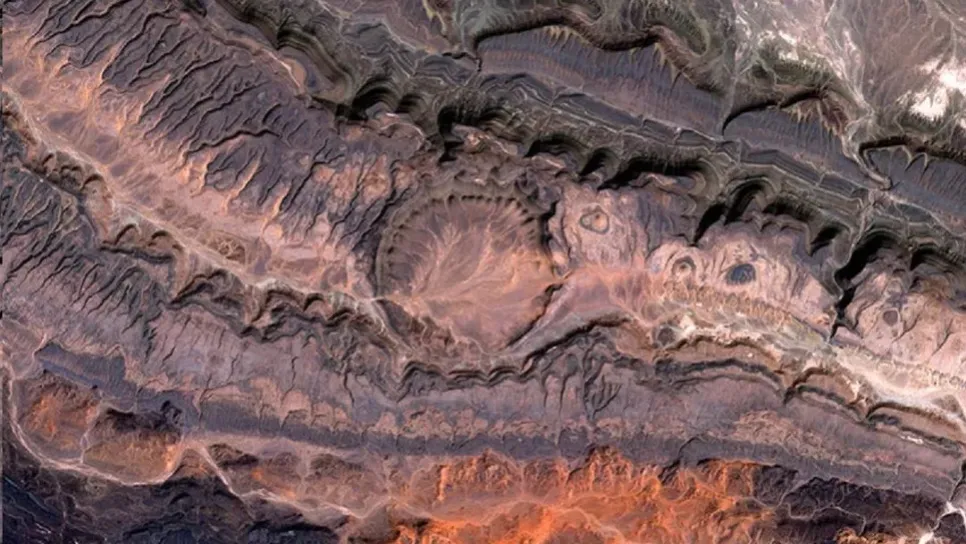
Dr. Ratiba Sahoui, an Algerian scientist from Bab Ezzouar University, recently revealed the presence of four meteorite impact crater sites within Algeria, a significant announcement made during a symposium in Oran focused on geological heritage. These sites contribute to Africa's total of thirty known impact locations, underscoring Algeria's unique natural endowment. Among these discoveries is the Ourgueziz crater, located in the Tindouf desert, which has been dated to 10,000 years old.
The Ourgueziz crater stands out as an exceptional geological formation and a rare transitional site globally. Dr. Sahoui has proposed classifying this 3.5-kilometer site as one of the world's most beautiful and important locations, meriting protection due to its accessibility and ease of study—qualities not shared by other transitional sites often found underground or submerged. Research conducted on the remnants within Ourgueziz indicates a recent formation and meteorite impact, dating back no more than 10,000 years, a finding that revises earlier studies from NASA which had estimated its age at 70 million years. This re-evaluation highlights the precision of local scientific investigation.
Beyond Ourgueziz, Algeria's geological wealth includes other notable impact sites such as the Talemzane crater in the Hassi R'Mel region, Tin Bidar, dated 66 million years ago, and Amguid, estimated to be 65 million years old. The earliest of these sites was initially discovered in 1955, with the remaining three identified between 1963 and 1980. These Algerian sites are considered among the most protected globally, primarily due to their remote locations in vast desert areas, which are largely devoid of vegetation and distant from populated regions. Further studies on these impact sites hold potential significance for identifying valuable minerals or energy resources, including oil and natural gas, contributing to national development.
The symposium also featured other notable scientific contributions, including findings presented by Dr. Anissa Dahoumane, also from Bab Ezzouar University, regarding excavations at Zarzaitine in the In Amenas area. These 2019 excavations uncovered remains of an extinct amphibian, Temnospondyl, and a larger species, Stenotosaurus-Ait Waali, previously documented only in Germany and England. The event underscored the importance of earth and universe sciences within Algeria's strategic initiatives to enhance its mining and mineral sector, with key participation from institutions like Sonatrach and the Research Center in Astronomy, Astrophysics and Geophysics. A cooperation agreement between Oran 2 University and the Hydro-Climatic Institute for Training and Research was also signed, signaling a collaborative approach to scientific advancement.