Algeria Signs Deals for Three Major Desalination Plants
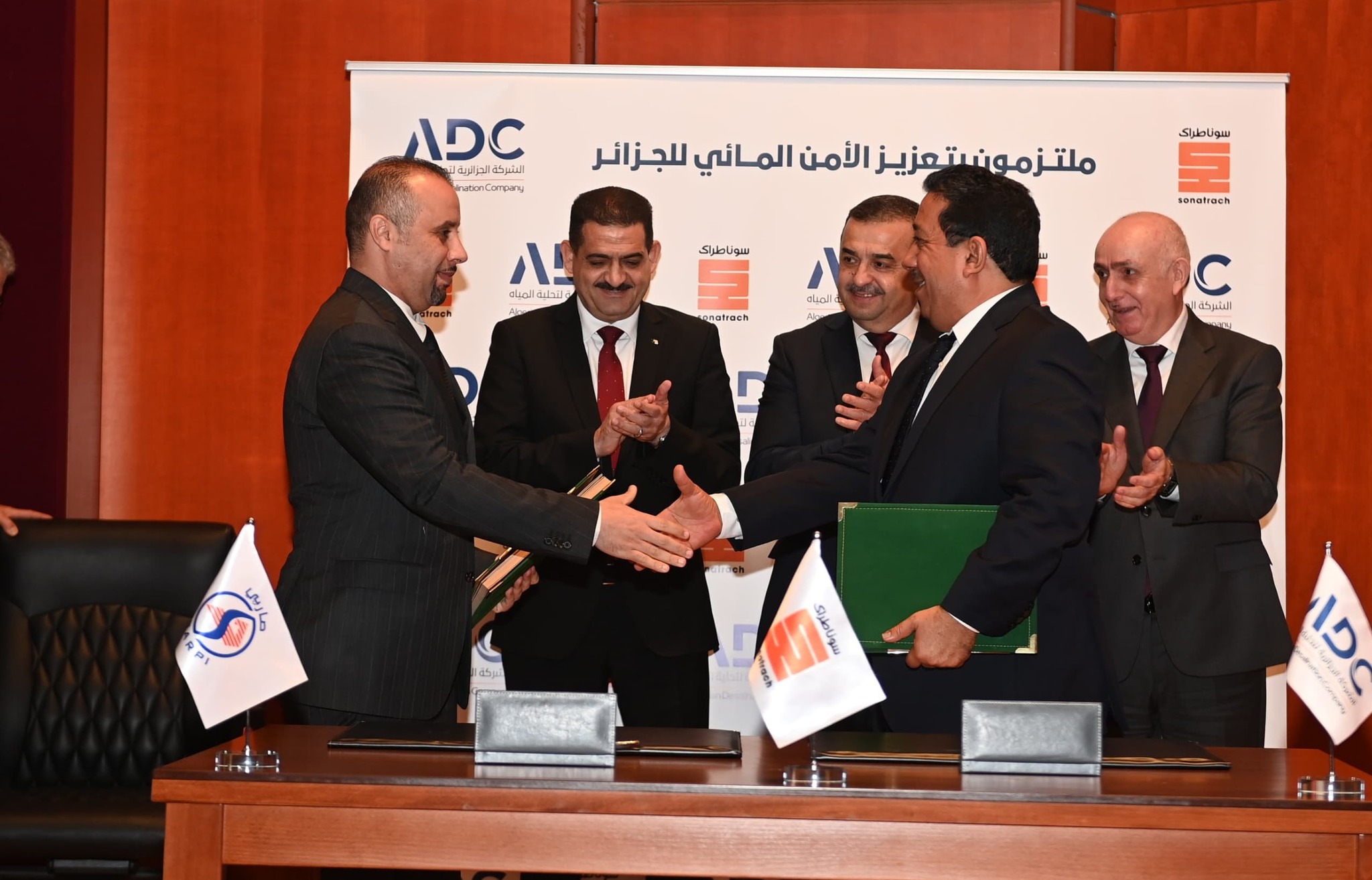
Minister of State, Minister of Hydrocarbons and Mines, Mohamed Arkab, today oversaw the signing of contracts for the construction of three major seawater desalination plants. The signing ceremony took place at the headquarters of Sonatrach’s General Directorate.
The contracts cover the construction of plants in the wilayas of Tlemcen, Chlef, and Mostaganem. A memorandum of understanding was also signed between the Algerian Water Desalination Company (ADC), a subsidiary of Sonatrach, and the Algerian Water Company (ADE).
The signing ceremony was attended by the Minister of Water Resources, Taha Derbal, the CEOs of Sonatrach, ADC, and ADE, as well as officials from national construction companies and a number of senior executives.
These projects are part of the first phase of the Second Supplementary National Program, approved by the President of the Republic. This program includes the construction of six major seawater desalination plants, each with a production capacity of 300,000 cubic meters per day. This will contribute to increasing the national capacity for desalinated water production to 5.6 million cubic meters per day by 2030.
The construction contracts cover the Ain Adjroud station in Marsa Ben M’hidi (Tlemcen), the Dhahra station in El Marsa (Chlef), and the Sidi Ledjel station in El Khadra (Mostaganem). The projects will be executed using an Engineering, Procurement, and Construction (EPC) model to ensure adherence to deadlines and approved technical standards.
The Ministry clarified that the Algerian Water Desalination Company (ADC), as a subsidiary of Sonatrach, will oversee these projects. Construction work has been assigned to leading national companies. Cosider Pipelines will handle the Tlemcen station, the National Company for Major Petroleum Works will be responsible for the Chlef station, and the Algerian Company for the Realization of Industrial Projects (SARPI) will build the Mostaganem station.
These projects aim to enhance sustainable water security, improve the quality of public water services, create a significant number of direct and indirect jobs, and support training programs, technology transfer, and the development of national expertise in the field of seawater desalination. This aligns with the national vision for sustainable development.